2013年8月19日 星期一

Three species breeding results of the Genus Dorcus

I have ever bred three species of the Genus Dorcus .

Their scientific names are Dorcus hopei binodulosus , Dorcus grandis moriyai & Dorcus hopei hopei .

According to some researches , we all know that the vast majority of Dorcus females only oviposit in decayed wood .

So i always laid some decayed wood in the bottom of the breeding containers , whether it is vertical or horizontal , both available .

In my cases , i got bone dry decayed wood from dedicated shops .

When i was going to set up a breeding container , i picked out some decayed wood whose hardness was proper for Dorcus females to oviposit in it .

Then , i placed the decayed wood vertically in a tub which had been filled some water , then , putting stones on the top of the wood to fix them thoroughly .

If the water had been absorbed totally , i would add water in the tub until the wood was filled with water .

Before placing the wood in the tub , i had weighed the wood , then , weighing the moist wood again , through the weight comparisons , i could know the wood moisture and adjust the humidity by absorbing water or drying out .

In the wild , females of stag beetles will ingest proteins by preying other insects , in captive breeding , i employed fishmeal as the protein source , i often sprinkled fishmeal on the jelly to feed them .

Once a breeding container had been prepared , i put a fertilized female in the container about one month and kept the breeding temperature in the range of 20 - 25 degrees Celsius .

As a reminder , D. h. h. females had a good chance to hibernate when the temperature was too low , so i bred them at room temperature in the end of spring and the beginning of summer .

For me , to retrieve the L1 larvae from hard decayed wood was not a easy thing , hence , after taking the female out of the breeding container , i would wait more than one month to retrieve the larvae .

Thus , i could break open the wood and retrieve the larvae easily , because most of the eggs had hatched and formed many tunnels inside the wood .

In this way , most of the larvae were old L1 or young L2 larvae , so i could put them into the prepared kinshi bottles directly or use fermented decayed wood flakes to feed them .

A breeding container had been set up on May 10th 2010 , i laid a piece of decayed wood in the bottom of the container and used decayed wood flakes to cover the wood .   

I put a D. h. h. female into the breeding container , then , taking it out of the container on June 13th 2010 .

2010-6-21 , i seen a larva in the bottom of the container , which means that the female laid eggs immediately when she was being put into the container .

2010-7-2 , i broken open the decayed wood with bare hand , but the middle portion of the decayed wood was still hard , so i put it back , this time , i just retrieved larvae from the decayed wood flakes and the soft portion of the wood chunk .

In the second time , i found the rest ten larvae in August 2010 .

Those larvae was fed on fermented decayed wood flakes , and turned into adults in May 2011 .

I bred Dorcus hopei binodulosus and Dorcus grandis moriyai on July 20th 2011 and July 28th 2011 respectively .

The females were taken out of the containers on August 21st 2011 and August 28th 2011 respectively .

I used a piece of hard decayed wood to breed  Dorcus hopei binodulosus and retrieved L2 larvae on October 1st 2011 , i put them into the prepared kinshi bottles , finally , the adults emerged  in July 2012 .

As for Dorcus grandis moriyai , i used a piece of middle decayed wood and a piece of soft decayed wood as the oviposition medium , i retrieved L1 larvae from the wood chunks , the female was not picky about wood hardness .

After retrieving the larvae , i used the prepared kinshi bottles to rear them , eventually , the adults emerged in August 2012 . 

For the three species , each harvest could achieve up to ten plus normally ,so i had prepared sufficient jars and food before retrieving larvae .

Related pictures :


                      Many oviposition holes on the decayed wood , 2011-8-21


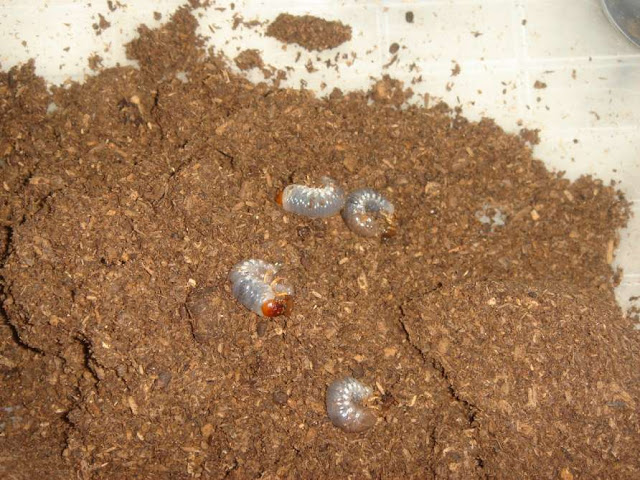
D. h. b. L1 larva

D. h. b. L2 larva

D. h. b. L2 larva

D. h. b. newly male adult 


D. g. m. L1 larva


D. g. m. larva in the middle decayed wood 

D. g. m. larva in the soft decayed wood


D. g. m. L3 larva (male)

D. g. m. male pupa


D. g. m. newly male adults in the artificial cells


 Kinshi bottles

Fermented decayed wood flakes

A D. h. h. larva chewed the decayed wood to form a tunnel


D.h. h. L1 larva and L2 larva


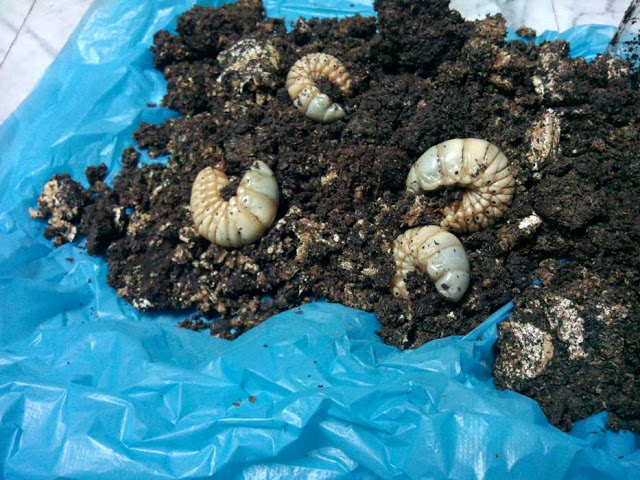
D. h. h. old L3 larva (male)


D. h. h. male pupa


D. h. h. newly male adult in the artificial cell 

D. h. h. female adult


2013年8月18日 星期日

The excavation procedures of the M. e. e. pupal cell

This morning , i decided to excavate the M. e. e. pupal cell .

After locating his position , i gently removed the dirt which covered on the top of the pupal cell .

Then , i used a screwdriver to poke a hole on the top of the cell .

My purpose was not to take him out of the cell , so i must open the cell without collapsing .

Hence , i expanded the hole gradually to avoid the dirt falling .

After a while , i finally saw him lay on his back in the cell .

He might be spooked by vibrating , so he turned  over quickly .

Considering that too many disturbances might injure him , so i covered moist napkins on the hole to maintain the humidity .

If my memory serves me , i started to rear them (3 males and 1 female) on January 24th 2011 .

One of his brothers turned into an adult in July 2012 .

His sister also turned into an adult in July 2012 , but she died in the pupal cell .

Recently , i found that the last male died in his pre-pupal period , his head capsule did not break open when he was molting .

Some pictures about this topic are shown as below :


Related pictures :

The picture was taken on January 24th 2011 .

The picture was taken on January 24th 2011 .

The picture was taken on November 20th 2011 .

The picture was taken on March 17th 2012 .


I raised two L3 larvae in one container .


M. e. e. male adult , the picture was taken on July 13th 2012 . 


M. e. e. female adult , the picture was taken on July 13th 2012 . 

2013年8月17日 星期六

Accepting unknowns

After seeing the videos which talk about information field , i surprised that there were too many things which i didn't know .

In the past ,  if i see something new , i always commented it with my perspective which has been affected by the background of the growth and the educational status .

Before observing the things phenomenons , the first thing in my mind was the impressions which had been used to guess or predict the things .

Once i mistook the predictions and thought that they were the truth and refused to try them in person , i have not known about their real phenomenons .


2013年8月15日 星期四

Fermented decayed wood flakes

When i made fermented decayed wood flaks , i usually used middle or soft decayed wood flakes to be the mainly material .

A lot of people estimate the amounts of the additives using the proportion of the volume of the decayed wood flakes and the additives .

For me , i always estimate the amounts of the additives in weight , the weight of the decayed wood flakes is the base , then , other materials quantities all depend on the base .

We all know that bacteria are the most important members of fermentation .

Whether the decomposition of the decayed wood flakes or the yield of the nutrients all rely on their action .

Bacteria need C and N to finish their life cycles ,  if we expect them to grow healthily , we must find the environment which they need .              

Materials all have unique  C/N ratio respectively , so we should calculate the total C/N ratio of  the decayed wood flakes and the additives .

When the total C/N ratio is too low , the mix will rot and emit some torturous odor ,  on the contrary , when the total C/N ratio is too high , the mix will not ferment due to lack of enough populations in it .

Besides , we also have to control the mixture humidity .

If the humidity of the mix is too low , it will dry out quickly .

If the humidity of the mix is too high , bacteria will not be able to breath .

As a reminder , the volume of the mix should not be too small , otherwise , it is difficult to remain the temperature .


New adult emerged

A M. e. elephas male pupa turned into an adult on August 8th 2013 .

The pupal cell was constructed against the wall of the container , when lights penetrating , i seen the pupa inside the cell swirl periodically .

His brother emerged earlier than he about one year , i have no idea about this , the phenomenon may be caused by the differences of the individuals .

When he was a larva ,  i employed humus to feed him and kept the container at room temperature .

I changed the substrate once 1-2 months .

I will take some picture a few days later .


2013年8月14日 星期三

My former blog

The link of my former blog is shown as below
http://g66599.blogspot.tw/
I will try to present the contents in English here .

The reasons of rearing and breeding beetles

When i was a child , i encountered my first beetle .
After reading some books , i found that it is an Allomyrina dichotoma male adult .
For me , it was unrivaled at that time .
whether the shape or the size , all let me feel amazing .
I would not settle for keeping an A. dichotoma male adult alive .
The desire for breeding A. dichotoma was aroused at the same time .
Then , my breeding career has been starting ever since that time .